Showing posts with label library. Show all posts

Friday, 11 February 2011

Fenland on Friday talk

Anglo-Saxon pendant*
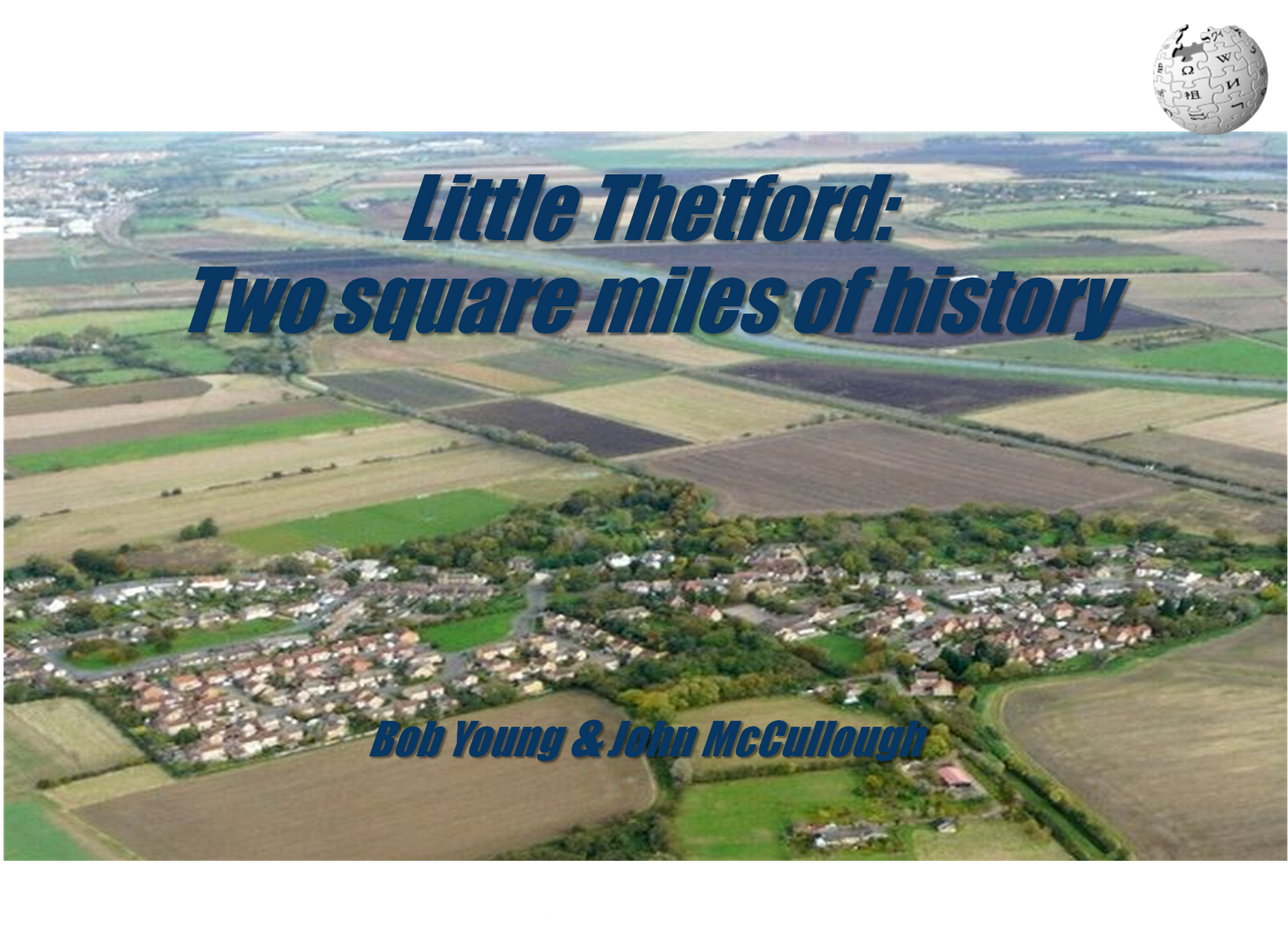
The Fenland on Friday's talk Little Thetford: Two square miles of history at the Ely library went well, or at least seemed to. We got the timing almost perfect — 83 slides in 50 minutes. Apparently my nerves did not show through although I was certainly feeling nervous. The room was at capacity — fifty.

There were interesting questions raised at the end. Mike Petty put forward the theory that Hereward the Wake may have fought the Normans along our Bronze Age causeway. I was able to show I had no evidence for this theory as all the artifacts found in that area are Bronze Age in origin. I had not covered Hereward during the talk as to me he is more of a legend than fact. I was able to discuss him as I had edited the Wikipedia article on him. I have also edited Wikipedia's entry on Gesta Herewardi — mainly a hatchet job as I recall, removing hearsay and unattributed text from it.

I was asked about the Little Thetford catchwater drain which I had not included in the presentation. I was however able to explain that I thought it was completed in around 1867. I have since determined it was cut "... about the year 1838 ...  costing £2,500 ..." (MacKay 1908 p. 352). I described the route as entering from Grunty Fen from the south-west then around the south and east of the village until passing north outside the village boundary to enter the River Great Ouse by gravity at the Braham Dock drain. The Little Thetford parish web site interactive map shows the route more graphically than I can describe it.

Dugdales 1662 pre-drainage map of
the Great Level. Top is south
Look at Grunty Fen, erm I mean Red Fen, now and consider what the Reverend Bentham (1778 p. 8) had to say "It is probable that no improvements can or ever will be made of this waste, unless the proprietors shall agree among themselves to inclose and divide it; ...". Grunty Fen was enclosed between 1857–1861 under the second annual Inclosure Act 1857 20 & 21 Victoria c. 20.


  • For pre-mid 17th century draining in general see Dugdale, W. (1662) The history of imbanking and drayning of divers fenns and marshes: both in forein parts, and in this kingdom; and of the improvements thereby. Extracted from records, manuscripts, and other authentick testimonies, by William Dugdale Esquire, Norroy King of Arms. Alice Warren. About 500 printed copies of this work were destroyed in the Great Fire of London and not republished until 1772 by Charles Nalson Cole. Dugdale's work was succeeded by Samuel Wells's two-volume History of the Drainage of the Great Level of the Fens (1828±30).
  • For Grunty Fen pre-draining see Bentham, J. (1778) Considerations and Reflections on the Present State of the Fens, &c. J Teulon.
  • For enclosure and draining in Grunty Fen see MacKay, T., Ed., (1908) The reminiscences of Albert Pell: sometime M.P. for South Leicestershire. J Murray. pp. 350–355
See also Little Thetford: Two square miles of history.

*Found in a ploughed field near the site of the Roman road Akeman Street one mile west of Little Thetford. Described by Lethbridge, T.C. 1953. Jewelled Saxon pendant from the Isle of Ely. Proceedings of the Cambridge Antiquarian Society 46, 1-3.

Tuesday, 8 February 2011

Little Thetford: Two square miles of history

Little Thetford ferry c. 19051
I have done all the preparation I can for my talk at Ely library between 10:30 and noon on Friday 11 February 2011. Bob Young and I have prepared all the powerpoint slides; all 85 of them. I have practiced the timing, which is roughly 45–50 minutes as required by the organiser, Mike Petty. This leaves time for his own announcements and any questions after our talk. A similar talk was given by Bob Young and Peter Hoare at the Ely & District Archaeological Society. I provided most of the slides for that talk. I have changed the slides for this coming talk to reflect more of the Wikipedia research that was done and to remove some of the heavy detail.

C14 St George's church2
Am I nervous? I sure am. However, I do hope I can show the audience the passion I have for this local history subject. I live in a small village of 693 residents (2001 census) within a two-square mile area. The village is a cul-de-sac, so we do not get passing motor traffic; except for the navigationally challenged. Historically, two railways passed either side of the village; now there is one railway. We have two airfields and moorings for boats. One can therefore visit the village by almost any transport method desired. We have archaeological evidence of occupation since the Bronze-Age, with written evidence of settlement since the Anglo-Saxon times. The village may have had a pre-plague centre further south than the current location and we have participated in the coprolite-rush of the late 19 century. Historically we have had four churches with two remaining and seven public houses with none remaining.

Please do join us at the talk. Numbers are limited. Come early to avoid disappointment.
1Photo The Cambridgeshire Collection
2Photo © 2010 John McCullough

Tuesday, 25 January 2011

Little Thetford on the map!

*Little Thetford looking south-west
Along with Bob Young, I will be giving a talk at the Library, 6 The Cloisters, Ely, Cambridgeshire, CB7 4ZH on Friday 11 February between 10:30 and noon on the subject Little Thetford: Two square miles of history. Tickets are available at the door for 2.50 GBP. Geologist Bob will introduce the talk which I will present.

The Little Thetford Wikipedia article was published on the Wikipedia front page today. Some of you may know I edit Wikipedia articles under the pseudonym Senra. Little Thetford started out as a stub article on 30 May 2010; very little content as shown here. Using the village website as a starting off point, I began researching the two square mile Cambridgeshire village and was hooked. I learned rapidly that, although it is easy for anyone to edit Wikipedia pages, the content you produce must be substantiated from reliable sources, otherwise it gets quickly removed by another editor. Following a couple of months in a steep learning curve, I submitted the article through the Wikipedia peer-review process eventually gaining featured article status on 27 July 2010. The article was finally published on the front page today. The English Wikipedia has around 3 million articles of which 3,000 reach featured status. My other articles are listed here.

Every Wikipedia article has a status ranging from stub through Good Article to Featured Article. Wikipedia does not publish the status of every article. To see such status, create a free Wikipedia account. The Wikipedia community value anonymity highly so you do not need to use your real name or a regular email address; a free hotmail address for example is fine. Once registered, you can see an articles status just below the title line. As an example, Wikipedia's article on Blooms' taxonomy is a start-class article which simply means it has not been submitted through the Wikipedia peer-review process.

Yes I know this has nothing to do with the PTLLS course, but if I cannot be proud for one day, when can I be?

*Photo © 2010 John Parish

Wednesday, 19 January 2011

More library books

Photo © 2005, CC BY-SA 3.0
See also Library books.

Visited the Ely library today. There was a distinct lack of course books. In fact, only two books with relevant class number, which is 300-Social sciences – 374-adult education, whilst the CRC library has at least two full shelves of 374 class books. Anyway, the two books I did get were:
  • Dawson, C 2003. Returning to education—A practical handbook for adult learners. How to books limited
  • Dawson, C 2006. The Mature Student's Study Guide—Essential skills for those returning to education or distance learning. How to books limited
Dawson (2006) does not mention Bloom but does mention something I am familiar with. Writers block. Two of her solutions to this condition are to "Write part of [the] assignment as a diary or a letter to a friend. It may help the words to flow and you can then rewrite when you feel up to it" and "Put together your bibliography or references – you are still working but you won't be affected by writer's block". Both very good reasons to continue this blog!

I also obtained Tiller, K 2002. English Local History. Sutton and also Burnby, J.G.L. 1983. A study of English apothecary from 1660–1760. Medical history supplement. Welcome Institute for the history of medicine but neither of these are for this course.

Thursday, 13 January 2011

Library books

Bill Woodrow's Sitting on History*
Following a visit to the college library today, I borrowed the following books, most of which are on the recommended reading list:
I am a little disappointed that I cannot find a way to access the college library catalogue from outside the college. This could be a small financial (travel costs) barrier to my learning.

*Image is a bronze sculpture. Photo © 2006 Grytr (John McCullough). Bill Woodrow's 'Sitting On History ' was purchased for the British Library by Carl Djerassi and Diane Middlebrook in 1997. Sitting on History, with its ball and chain, refers to the book as the captor of information which we cannot escape.

As an aside, I really need to check my Flickr account more often. This image was used to illustrate an article by Kathryn Perera, 12 July 2010 Michael Gove's history lesson, Progress Online. Coincidentally, the article discusses education!