Showing posts with label PTLLS. Show all posts

Tuesday, 15 February 2011

Le pièce de résistance ...

Aircraft flight control system
... or just a load of crock? We shall see. In any event, the micro-teach part of the PTLLS course looms even nearer.

We were given our groups and dates for the micro-teach sessions yesterday. There are two groups with eight students per group. Four students from each group present their topics in week 1 and four in week 2. I am in group 1 in session 2. My own presentation is at 17:40–18:10 on 28 March in room B002. Whilst I do not know what topics everyone is presenting I do know we will have the pleasure of a session on mask-making (Debbie), be taught how to sing (Vikki), make some pottery (Jenny) and bath a baby (Karen).

I previously comitted to teach on one of four topics according to voting on my blog here. Voting has been fast and furious with a total of six people bothering to vote. Four voted for the successful take-off and landing topic so that is what my session will be.

My experimental lessons on my unsuspecting friends have revealed some timing and skill issues in the practical part of my session. The sample take-off phase has been performed well by my guinea-pigs. The landing phase has had very mixed results. I had originally thought I could help anyone land from 800 feet. Indeed I can but not without significant help from me which tended to leave the subject dispirited. The issue I have is that my friends, none of whom have any flying experience, all had difficulty maintaining direction. I have run out of experimental subjects so I have to make a decision.

Short-final Cambridge runway 23.
Same view from 800'
I have thus reduced the height to 400 feet from which a successful landing will then occur. Hopefully, the student will not drift too far from the correct glide-path in this shorter time. The problem may of course be my teaching and not the student. I may be over-emphasising the need for good speed control without emphasising enough the need for good directional control.

This is a contrived teaching session anyway. In real-life, a student will have experienced a lot more ground and air lessons before being taught to land. The effects of controls for example would be an early lesson where the student learns that the ailerons are used to turn. We use left and right joystick movement in our simulator. In Thom (1997) the effect of controls is lesson 4a whilst powered approach and landing is lesson 13a. What was a surprise to all my guinea-pigs was that, in order to turn, the stick is not held in the direction desired. Rather the stick is moved briefly in the required direction and then returned to the centre once a bank has been established. To stop the turn, the stick is moved in the opposite direction briefly then returned to the centre. This is all counterintuitive and very difficult to get across in a five minute lesson.

I therefore have my work cut out here.

Animation 2006 Piotr Jaworski
Simulation. Note the airspeed (70 knots), altitude (430 feet above mean sea level; approx. 400 feet above ground level) and on glide-path and on glide-slope. The airport buildings are to our right

Further reading
Thom Trevor, 1997. Flying Training. The air pilots manual. Volume 1. Airlife.
Langewiesche Wolfgang, 1944. Stick and Rudder. An explanation of the art of flying. McGraw-Hill.

Monday, 14 February 2011

Every day in every way ...

Hey! I told you no tongues
My mother, rest her soul, encouraged me to repeat to myself daily "Every day, in every way, I am getting better and better". In today's PTLLS lesson, I learned what that phrase really means. It is a manifestation of psychologist Martin Seligman's teachings on optimism. Seligman's research showed that optimists are successful. We were informed that optimism is learned behaviour and that if we can encourage optimism in our students it becomes a self-fulfilling prophecy.

I thought today's image was distinctly appropriate. Today is of course Valentine's Day. It also seems appropriate if we consider that the male green parakeet is the eternal optimist.

We also discussed diversity and equality by enumerating words that might represent barriers to our students. Our group considered such barriers as age, race, language, sexuality, disability (physical and mental), beliefs, financial, background (social), prior education, health and peer pressure. Maslow's hierarchy of needs cropped up again, this time as a barrier to learning. For example, hunger prevents learning.

Marva Collins, as a successful and inspirational teacher of the under-privileged, was briefly examined. An overtly optimistic educator, Marva believes that "there is a brilliant child locked inside every student". Derek Paravicini was mentioned to illustrate the point that intelligence is not just measured by IQ tests. He is a severely disabled autistic savant who is an exceedingly gifted musician .

All in all a very interesting lesson.

Update: It appears that the auto-suggestive mantra "Every day, in every way, ..." was invented by Émile Coué de Châtaigneraie not my mother. It is now known as a Couéism. I so wanted to believe it was my mother.

Every day, in every way, I am getting better and better

Monday, 7 February 2011

Feedback

Well done. Now get another one*
Our week five lesson on the PTLLS course was on the topic of assessment; the value of feedback. Now this is interesting. Whilst practicing my micro-teaching exercise on my wife this week she accused me of giving condescending praise. "Stop patronizing me!" she said. I had been spouting wallpaper phrases at her such as "Well done", "That was good", "Excellent". I should have been saying things like "Good but watch your speed", "You need to be more gentle with the control" or "Try to anticipate your next action earlier". I need to give more thought and practice in giving constructive, directed, personal or reflective praise.

We discussed summary assessment methods, such as grading, in comparison to the more powerful formative assessment methods such as continuous feedback. Lewis also touched on the value of summarising the lesson. This is something that has been drilled into me whilst being trained to train.
  • Tell them what your are going to tell them
  • Tell them
  • Tell them what you told them
Those who disagree suggest that being repetitive is bad. They recommend that you be concise in your summary as the audience, erm your students, remember the last thing you said so make it count. Whatever method you prefer, I do like the simplicity of the above tell them mantra. It helps me structure my presentations, and I hope my teaching, into easily manageable chunks.

*Photo © 2006 John McCullough

Tuesday, 1 February 2011

Outline lesson plans

Reflecting*
This is work-in-progress and will change over time. As part of the PTLLS course, we have to prepare and teach a 30 minute lesson to our peers. I have committed to teaching one of the following topics according to the voting, see top right of this page. I set out below my present thoughts on the aims and the outcomes of each of the topics.

Introducing Wikipedia editing
  • Aim – To Introduce new editors to Wikipedia
  • Outcomes
    Students will register on Wikipedia
    Introduction to students own talk page
    Edit own talk page
    A brief introduction to Wikipedia help, including the topic notice-boards and be given the opportunity to ask a question on a topic of their interest
    Some Wikipedia rules will be covered such as reliable sourcing. Some students may feel confident enough to edit an article but there will not be time in this lesson to see if such edits stick as others, usually more established Wikipedians, may remove such edits
  • Multiple computers will be used so each student has a chance to edit at least their own talk page
Little Thetford local history
  • Aim – to introduce students to local history research
  • Outcomes
    More of a presentation than a lesson. Intend to cover brief local history of Little Thetford
    Use of research tools
    How to locate and summarise sources
    How to reject unattributable hearsay
  • Powerpoint presentation and discussion
A blog and how to create one
  • Aim – to introduce students to blogging
  • Outcomes
    Understand what a blog is compared to a website
    Use blogger as one of many tools to create a blog
    Understand some of the pre-planning that may be useful
    Introduction to templates
    How to load an image
    Create a blog
  • Multiple computers will be used so each student has a chance to create a blog
Landing on rwy 23 at Cambridge
Successful take-off and landing
  • Aim – to provide the student with an introduction to flying
  • Outcomes
    Using MS Flight simulator, each student will take-off from Cambridge then land
    Understand take-off and landing speeds using the airspeed indicator
    Importance of gentle control movement
    Importance of wings level
    Importance of visual cues: horizon (take-off) and runway aspect (landing)
    Instructor will control power, flaps and correct attitude as necessary
  • Five minute introductory powerpoint presentation demonstrating the techniques
  • Special notes: The lesson will be constrained as we will be using only one simulator. Each student will have a successful take-off and landing with some help from the instructor; no one will crash! For this reason, numbers will be limited to a maximum of four. Students not flying will be encouraged to take notes
* Photo © 2006 John McCullough

Tuesday, 25 January 2011

Little Thetford on the map!

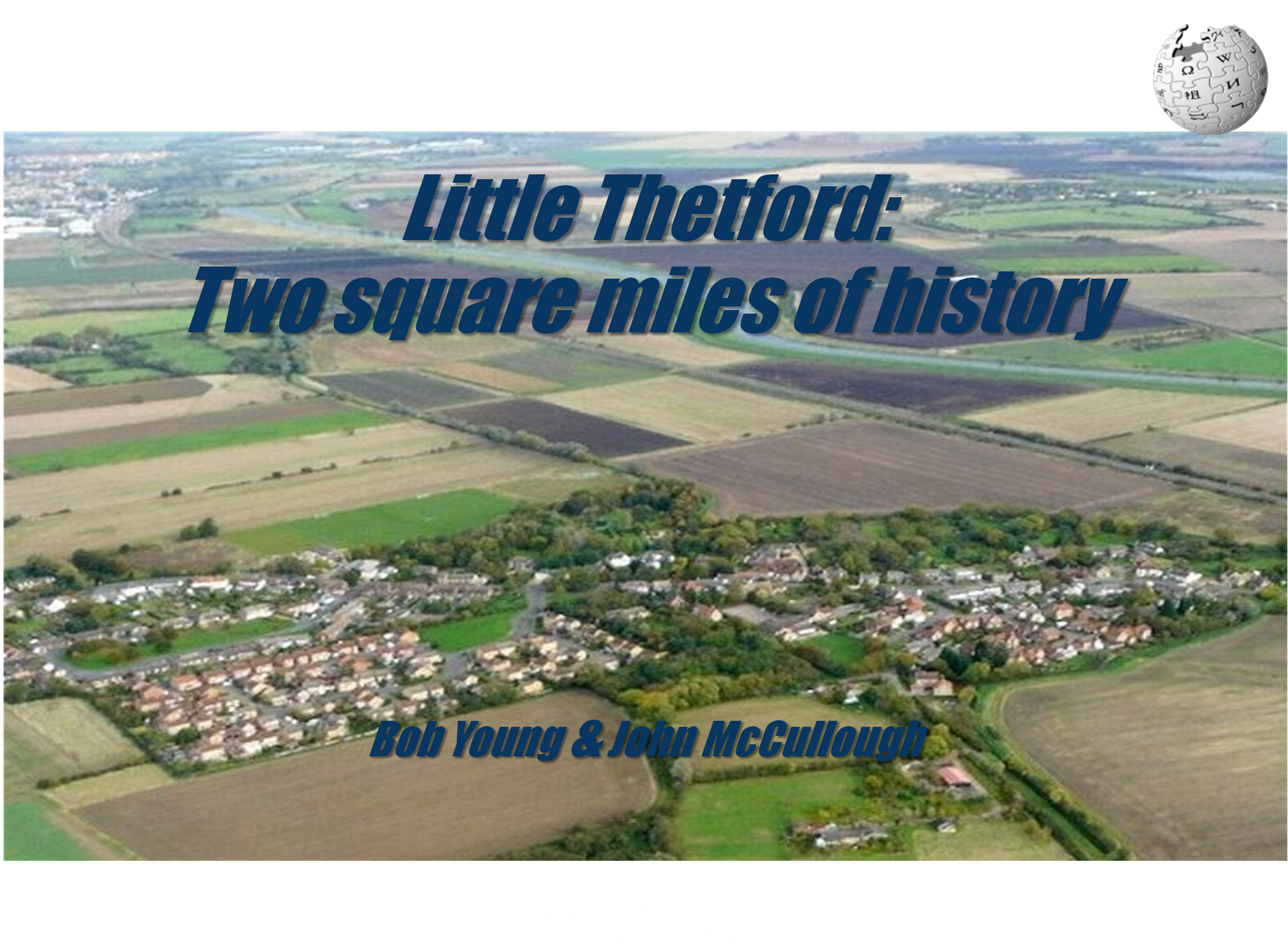
*Little Thetford looking south-west
Along with Bob Young, I will be giving a talk at the Library, 6 The Cloisters, Ely, Cambridgeshire, CB7 4ZH on Friday 11 February between 10:30 and noon on the subject Little Thetford: Two square miles of history. Tickets are available at the door for 2.50 GBP. Geologist Bob will introduce the talk which I will present.

The Little Thetford Wikipedia article was published on the Wikipedia front page today. Some of you may know I edit Wikipedia articles under the pseudonym Senra. Little Thetford started out as a stub article on 30 May 2010; very little content as shown here. Using the village website as a starting off point, I began researching the two square mile Cambridgeshire village and was hooked. I learned rapidly that, although it is easy for anyone to edit Wikipedia pages, the content you produce must be substantiated from reliable sources, otherwise it gets quickly removed by another editor. Following a couple of months in a steep learning curve, I submitted the article through the Wikipedia peer-review process eventually gaining featured article status on 27 July 2010. The article was finally published on the front page today. The English Wikipedia has around 3 million articles of which 3,000 reach featured status. My other articles are listed here.

Every Wikipedia article has a status ranging from stub through Good Article to Featured Article. Wikipedia does not publish the status of every article. To see such status, create a free Wikipedia account. The Wikipedia community value anonymity highly so you do not need to use your real name or a regular email address; a free hotmail address for example is fine. Once registered, you can see an articles status just below the title line. As an example, Wikipedia's article on Blooms' taxonomy is a start-class article which simply means it has not been submitted through the Wikipedia peer-review process.

Yes I know this has nothing to do with the PTLLS course, but if I cannot be proud for one day, when can I be?

*Photo © 2010 John Parish

Monday, 24 January 2011

How to make a cup of tea ...

*Cup of tea anyone?
... erm! Seriously.

The class had been split into 5 groups last week. As I missed last weeks lesson, I made a fourth body on an already function group consisting of Jo, Linda, and Karen. As a group we were all asked to create a lesson plan for any activity we could think of. One group chose the topic writing a story, another making a cheesecake, a third chose baking a dozen buns, the fourth settled on email and we chose making a cuppa.

Our lesson outcomes were that the student would learn how to be able to list the equipment and incredients necessary to make a cuppa; be able to make a cuppa using a tea bag; and understand the risks involved. The differentiated outcomes we discussed included using leaf tea, the ability to make different strength teas and understand the health and safety legislation involved. Just to be clear, our target audience for this life-skills lesson was intended to be students with special needs. Have you stopped laughing at us yet?

We also (for me at least) revisited Bloom (1956) and Maslow (1943) and were told that we would get SMART next week; Simple, Manageable, Achievable, Realistic, Timely? Maslow in particular has cropped up throughout my life. I first came across the dude on a Grand Metropolitan managerial training course in the mid '70's; then University in at least one psychology module; then in business as part of staff motivation courses; in aviation as part of human factors and now in education whilst learning to teach. Still, I guess the dude meant well, even though he only studied the top 1% of a specific campus population.

Those of you who know me may not know I have difficulty with the names of new people I meet. This condition, which I have had all my life, came to a head during this evenings lesson when I kept calling Karen, Linda (or was it Linda, Karen?). I even thought Lewis was James! Thank you Jo for correcting me on at least three occasions! After the lesson, I looked the condition up and the nearest I can come to is a form of agnosia called prosopagnosia. They tell me that if you can name the disease, you can feel better about it. Hmmm. Perhaps I should try some self-help.

*Cup of Tea anyone © 2011 John McCulloug. For the observant amongst you, I take my tea black with one sugar! 
Edited once on 25-1-2011 at 15:120

Wednesday, 19 January 2011

More library books

Photo © 2005, CC BY-SA 3.0
See also Library books.

Visited the Ely library today. There was a distinct lack of course books. In fact, only two books with relevant class number, which is 300-Social sciences – 374-adult education, whilst the CRC library has at least two full shelves of 374 class books. Anyway, the two books I did get were:
  • Dawson, C 2003. Returning to education—A practical handbook for adult learners. How to books limited
  • Dawson, C 2006. The Mature Student's Study Guide—Essential skills for those returning to education or distance learning. How to books limited
Dawson (2006) does not mention Bloom but does mention something I am familiar with. Writers block. Two of her solutions to this condition are to "Write part of [the] assignment as a diary or a letter to a friend. It may help the words to flow and you can then rewrite when you feel up to it" and "Put together your bibliography or references – you are still working but you won't be affected by writer's block". Both very good reasons to continue this blog!

I also obtained Tiller, K 2002. English Local History. Sutton and also Burnby, J.G.L. 1983. A study of English apothecary from 1660–1760. Medical history supplement. Welcome Institute for the history of medicine but neither of these are for this course.

Tuesday, 18 January 2011

Bloom's taxonomy

Bloom's taxonomy
Benjamin Bloom was an educational psychologist most known for his classification of educational objectives in his 1956 handbook (Bloom 1956). Bloom's taxonomy organises learning objectives for educators into three domains,  Affective (emotional), Psychomotor (physical), and Cognitive (knowledge and thinking). These domains can be remembered using such mnemonics as KAS for Knowledge-Attitude-Skills or Do-Think-Feel (Chapman 2006–2009).

Objectives for learning within each domain are organised hierarchically such that a higher level objective is not fulfilled until all lower level objectives have been attained. This constrained hierarchy is similar in structure to  Abraham Maslow's hierarchy of needs (Maslow 1943), though of course for a different purpose.

One mnemonic that I recall, probably from University, is EDIT which I think stood for Explain, Demonstrate, Instruct, Test. It is also an acronym. On reflection, this is more of a skill mnemonic such as for driving instructing rather than an education one. Another mnemonic, probably from business presenting, is TTTTell them what you are going to tell them; tell them; tell them what you told them. I have used T=V to remind myself that variety is important in presenting, training and from what I have read recently, education too.

Because not all students learn in the same way and at the same pace, we should plan for individual learners. Francis and Gould (2009 p. 75) consider Bloom's taxonomy in helping to identify multiple lesson objectives in order to provide learning suitable for the different abilities each student.

This post is work-in-progress. Below is a list of sources that I have determined contain one or more references to Bloom. They have been marked with an "*" if I have not yet used them in the above notes

Bloom B S (ed.) (1956) Taxonomy of Educational Objectives, the classification of educational goalsHandbook I: Cognitive Domain New York: McKay
Chapman, Alan (2006-2009) Businessballs.com: Bloom's taxonomylearning domains, accessed 18 January 2011
*Gravells, A. (2007) Preparing to Teach in the Lifelong Learning SectorLevel 3 coursebook. Learning Matters
Maslow, A.H. A Theory of Human Motivation, Psychological Review 50(4) (1943):370–96.
*Petty, G. (2004) Teaching Todaya practical guide. Nelson Thornes
*Walkin, L. (2000) Teaching and Learning in Further and Adult Education. Nelson Thornes

Monday, 17 January 2011

Not just another brick in the wall?

Another Brick in the Wall!
The students that we teach are all different, unlike the school children referred to in Pink Floyd's rock opera, The Wall "Another Brick in the Wall, Part II". Examine this image carefully. There is one whole brick and parts of four other bricks shown. Even though we cannot see five full bricks, we can see that every brick is different. If we could look at this wall from a distance, we would think that every brick was the same.

We can view our students in the same way. Stand back from them and we can believe that they are all the same; after all, they have joined our course! Look more closely however and we spot many differences. Each student learns in a different way—see the VARK learning preferences questionnaire. Each student has different motives for completing the course—such as a requirement for their job or simply a wish to better themselves. Each student will have barriers to learning - such as financial, work pressures or home circumstances. Barriers may change over the course. A student may be ill or feel under pressure as the course progresses. Being sensitive to these differences, within organisational resource constraints, may help us provide a learning environment helpful for all of our students.

We should also consider diversity, but that is for another lesson.

Friday, 14 January 2011

Stand and deliver!

Cambridge: Short-final rwy 05*
From Gravells (2007) p. 8 I need to consider what topics I can teach. I also need to start thinking about the 30 minute micro-teach exercise I have to deliver as part of the course. Below I list my thoughts so far
  • I lectured on a one year Pascal programming course for three years, two hours per week, from 1984. I was responsible for the course content, I set coursework and an end of course examination. In those days, you did not need a PTLLS!
  • my career background is 23 years in IT, which is a very broad subject. I have been a senior manager from my first IT job in 1987. I am experienced in the software development life-cycle, most computer programming languages, broad operating system knowledge, systems design & deployment engineering, skilled network analyst, security specialist, competent operations analysis & support and excellent desktop systems knowledge in both office software & graphical design fields. I have also been a marine engineer and a steak-house (Schooner Inns) manager
  • I am an amateur photographer with no particular specialist subject, though I am told I have an eye for a photograph. I am certainly skilled in digital image correction and manipulation. For example I hand-stitched 26 images for the panorama of Ely Cathedral (below); the images of the spiders web and British Library sculpture are mine as is the highly manipulated Hello World on this page
Anything to tap into here?

  • I am a160 hour private pilot. Not only can I fly a light aeroplane (twin piston) but in gaining my licence I have studied Air law and operations procedures, human performance and limitations, meteorology, navigation, principles of flight, flight performance & planning and aircraft technical & general knowledge. I think flying also teaches you to have a continual eye for safety of your self and others
  •  I have an interest in local history via editing Wikipedia, e.g. Little Thetford. This has given me an amateur introduction to palaeontology, archaeology, geology, human history, UK heritage, zoology, botany, cartography and a host of research oriented skills such as identifying and qualifying sources, copy-editing and accurate summarising
  • I have an interest in cryptography, a branch of mathematics which also interests me deeply. As an example, my degree course was a business oriented computer studies degree though I was more interested in the computer science aspects. I managed to study a lot of computer science during the degree (hence my teaching post-grad) and built a 3D real-time wire-frame rotating true-perspective model of Wearmouth Bridge on a Harris H100 time-sharing computer in Fortan IV. I completed the required mathematics from first principles. I was very proud of this feat; especially as the computing engineers said it could not be done! I also built a BSL animated language demostrator using Pascal on an early IBM PC. My wife drew the pictures for it. I regret not writing this up as the compression techniques I used, to get real-time hand movements, anticipated mpeg compression by a few years; and my method was lossless!
Panorama, Ely Cathedral*
I suspect the above shows I have a number of life skills that I may be able to pass on to others. I know I show an enthusiasm for everything I do in life although the last five years without a full-time role have been somewhat dispiriting.

For my 30 minute micro-teach session, I am definitely leaning towards an introduction to Wikpedia editing, though I am not sure how interested my colleagues on the course will find this topic. Perhaps I should write a brief lesson plan and test it on my wife first!


* Ely Cathedral © 2005 John McCullough; Tap © 2006 John McCullough; Short-final © 1999 Marilyn McCullough (I was flying!)

Thursday, 13 January 2011

Library books

Bill Woodrow's Sitting on History*
Following a visit to the college library today, I borrowed the following books, most of which are on the recommended reading list:
I am a little disappointed that I cannot find a way to access the college library catalogue from outside the college. This could be a small financial (travel costs) barrier to my learning.

*Image is a bronze sculpture. Photo © 2006 Grytr (John McCullough). Bill Woodrow's 'Sitting On History ' was purchased for the British Library by Carl Djerassi and Diane Middlebrook in 1997. Sitting on History, with its ball and chain, refers to the book as the captor of information which we cannot escape.

As an aside, I really need to check my Flickr account more often. This image was used to illustrate an article by Kathryn Perera, 12 July 2010 Michael Gove's history lesson, Progress Online. Coincidentally, the article discusses education!

VARK learning style questionnaire

I completed the VARK learning style questionnaire as recommened within part of week 1. My scores were:
I therefore have a strong Read/Write learning preference. I find that surprising as I thought I had a strong preference for visual learning using graphs and charts. Still, I do like reading. I read a great deal; mainly non-fiction.

VARK © 1992: Fleming, N.D. and Mills, C. (1992), Not Another Inventory, Rather a Catalyst for Reflection, To Improve the Academy, Vol. 11, 1992., page 137

Wednesday, 12 January 2011

Is there humour in education?


When we communicate, we should take care to ensure the words we use are well understood. If in doubt, we can use a dictionary, such as the Oxford Dictionary of English (OED). Most UK libraries provide free on line access to this excellent resource. However, a dictionary may still lead us astray ...

  • Children's Logic: "Give me a sentence about a public servant," said a teacher. The small boy wrote: "The fireman came down the ladder pregnant." The teacher took the lad aside to correct him. "Don't you know what pregnant means?" she asked. "Sure," said the young boy confidently. 'It means carrying a child"
  • Source: recent viral joke but this one seems to have travelled the web too!
See the OED entry for the adjective pregnant

Some initial reading

© Michael Jastremski
Initial reading with links to mainly web based sources at this point.
The teacher training cycle
Administration
  • eHow: "The goal of recordkeeping within an adult literacy program is to assist in measuring the progress of students. The strength of literacy skills and overall capabilities of a student can be discovered through recordkeeping."
The teacher as a tutor
  • Wikipedia/teacher: "A teacher who facilitates education for an individual student may also be described as a personal tutor"
  • Contrast above with Wikipedia/Tutor: "A tutor is a person employed in the education of others, either individually or in groups." and OED: Tutor v. "To act the part of a tutor towards; to give special or individual instruction to; to teach, instruct (in a subject)."
The boundaries
  • From UWLAX.EDU: "Healthy boundaries for teachers" (PDF)
    Professional behaviour is a priority
    Use caution with self-disclosure
    Beware of boundary violations: take time to respond
    Be observant
    Don't be afraid to correct inappropriate behaviour [firm but fair]
    Use extreme caution with physical contact or touching
    Be prepared

PTLLS course at Cambridge Regional College

Photo: © 2006, John McCullough
I started as a student in the Preparing to Teach in the Lifelong Learning Sector (PTLLS) course (CA5PTLLSJ) on Monday 10 January 2011 17:30–20:30 at Cambridge Regional College. The course can be followed by a Certificate in Teaching in the Lifelong Learning Sector (CTLLS one year) or a Diploma in Teaching in the Lifelong Learning Sector (DTLLS two years).

The sixteen other students and I met the lecturers, James Woodworth and Lewis Williams. Both very nice. The administration was a little trying. My course offer
letter informed me that I would be able to pay the first evening, which turned out not to be possible due to the unavailability of the finance department, whose normal hours are 09:00–17:00. Still, I was able to pay over the telephone the following day. With my newly acquired student number, and after an exchange of emails with a very friendly ILCT Systems Administrator, I was able to log in to the course Virtual Learning Environment.

The course, the timetable and the assignments were explained. We were informed that the course could be studied at level 3 or 4. The basic difference is that level 4 students would be expected to complete an additional assignment and maintain Harvard citation standards throughout. We were told it was not compulsory to continue level 4 if we started that way and decided to continue at level 3. We were also told that completing the course at level 4 awards no special concessions for further study.

Then the first lecture started with the topic on the defining characteristics of an effective teacher. As a class we considered different words to describe an effective teacher such as inspiring, creative, encouraging.